
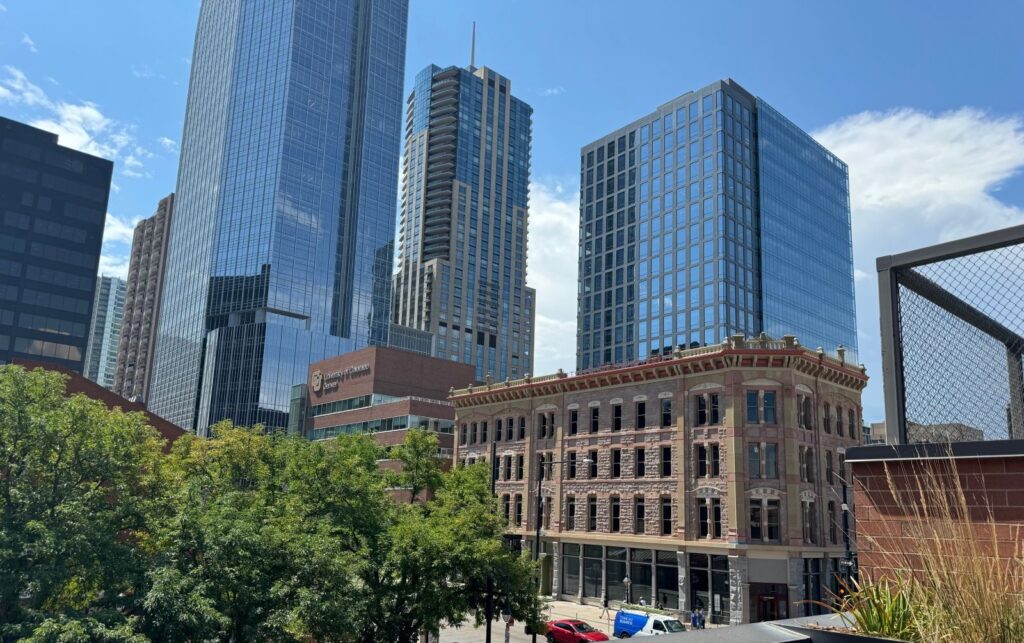
Some downtown Denver office buildings and residential properties have changed hands at substantial discounts to their previous purchase prices. Others have experienced significant declines in appraised value, entered receivership, or returned to lenders through foreclosure.
These transactions have attracted considerable attention as downtown Denver continues to contend with elevated office vacancies, changing employment patterns, and higher financing costs. Yet the market is not uniformly distressed. Significant commercial and multifamily transactions continue to occur, demonstrating that investors are still willing to commit substantial capital to well-located properties.
For investors with available capital and a disciplined acquisition strategy, the current market raises an interesting question: Are today’s reduced valuations creating opportunities to acquire downtown Denver real estate at an attractive long-term basis?
How Did Downtown Denver Get Here?
Before the pandemic, downtown Denver was a vibrant business, residential, entertainment, and cultural center. Its office towers supported a substantial daytime population, while restaurants, hotels, sporting events, and entertainment venues contributed activity beyond traditional business hours.
COVID-19 dramatically altered those patterns. Business closures and restrictions reduced downtown activity, while the rapid adoption of remote work fundamentally changed office demand. Even as businesses reopened, many employers retained hybrid schedules, reduced their space requirements, or reconsidered the economics of maintaining downtown offices.
Additional challenges compounded the downturn. The prolonged reconstruction of 16th Street disrupted pedestrian activity and affected surrounding businesses. Concerns about crime and homelessness influenced perceptions of downtown, while reductions in federal office operations placed further pressure on employment and occupancy.
The residential market also felt the effects. Reduced downtown activity, changing housing preferences, and competition from newer residential developments contributed to pricing pressure on existing condominiums. Rising HOA fees, insurance expenses, and other ownership costs created additional challenges for residential buyers and investors.
Interest rates introduced another significant complication, particularly for commercial property owners. Unlike conventional residential mortgages, commercial real estate loans frequently involve shorter terms, often with substantial balances due at maturity. Properties acquired or refinanced during periods of low interest rates may now face significantly higher borrowing costs, even as declining rental income and valuations reduce the amount lenders are willing to advance.
An owner may be current on every loan payment yet face a significant problem when the loan matures. Declining valuations, higher interest rates, and more conservative underwriting may reduce the amount of replacement financing available. The borrower may be required to contribute substantial additional equity to refinance the existing debt, even when the property continues to generate positive operating income.
For investors who experienced the commercial real estate downturn following the 2008 financial crisis, some of these challenges may sound familiar. Although the underlying economic conditions differ, refinancing difficulties, loan extensions, negotiated workouts, and distressed sales can produce similar investment opportunities for buyers with available capital.
Together, these factors have contributed to a substantial repricing of certain downtown assets.
A Market of Contrasting Transactions
Several office transactions illustrate the extent of the valuation adjustment.
The Wells Fargo Center at 1700 Lincoln Street, commonly known as the Cash Register Building, was valued at approximately $475 million in 2019. A May 2026 appraisal placed its value at approximately $85 million. The property entered receivership, illustrating the challenges of resolving a large commercial mortgage when market values have fallen substantially.
Trinity Place at 1801 Broadway sold for approximately $6 million in late 2025, compared with its $40.2 million purchase price in 2019. The historic Symes Building at 820 16th Street, which sold for $17.2 million in 2022, changed hands in October 2026 for approximately $2.7 million.
The residential investment market has also experienced notable adjustments. Civic Lofts, a 176-unit apartment property, reportedly sold for approximately $30 million in June 2026 after being acquired for $63 million in 2022.
Yet these transactions represent only part of the picture.
The Fitzgerald, a 282-unit luxury apartment property at 1840 Market Street, sold for approximately $110 million in September 2026. In the office sector, One Platte traded for $135 million in July 2025, while 17th Street Plaza sold for $132.5 million earlier that year.
The 17th Street Plaza transaction is particularly interesting because its sale price was reportedly comparable to the amount paid for the property in 2009, rather than reflecting the extraordinary declines experienced by some competing buildings.
These transactions demonstrate that investors continue to distinguish among properties based on location, occupancy, physical condition, income potential, and future capital requirements. A substantial transaction price does not necessarily indicate a premium valuation, just as a distressed sale does not establish the value of every property in the market.
Downtown Denver is not one market moving uniformly in one direction. Individual property characteristics and investment strategies matter considerably.
A Different Approach to Downtown Investment
Much of the discussion surrounding distressed office properties has focused on conversion to residential, hospitality, or other uses. While conversions may be appropriate for certain buildings, they can involve substantial construction costs, regulatory requirements, and physical limitations.
Conversion is not the only strategy.
The recent acquisition of the Symes Building illustrates an alternative approach. Rather than pursuing an immediate change of use, the new ownership intends to retain office occupancy and offer substantially reduced rental rates.
A lower acquisition basis may allow an investor to compete for tenants at rents that would not have supported the previous owner’s debt structure or investment expectations.
Similar considerations may apply to retail, mixed-use, and multifamily properties. Investors may find opportunities to acquire existing income-producing assets at prices that support more conservative operating assumptions, with the possibility of additional appreciation as surrounding market conditions improve.
For some investors, the strategy may resemble land banking: acquiring a well-located asset during a period of depressed demand and holding it through a longer market cycle.
Unlike vacant land, however, an existing building requires continuing expenditures for property taxes, insurance, maintenance, security, utilities, and capital improvements. Tenant improvements and leasing commissions may add substantial costs, particularly when occupancy is low.
The economic advantage of a discounted purchase can disappear quickly if the investor underestimates these obligations. A successful long-term strategy requires understanding the property’s current operating economics, future capital requirements, and the resources necessary to sustain ownership through an extended recovery period.
What Could Shape Downtown Denver’s Next Chapter?
While downtown’s recent difficulties are substantial, several major projects could contribute to its longer-term evolution.
The proposed Broncos stadium development at Burnham Yard could create a new mixed-use destination near downtown, incorporating residential, commercial, entertainment, and public spaces. Its potential significance extends beyond football, particularly if surrounding development generates activity throughout the year.
The planned redevelopment of the Elitch Gardens property through The River Mile project could introduce thousands of additional residences, commercial space, retail, and recreational amenities. Similarly, planned improvements to Ball Arena and development of surrounding property could further strengthen the area as an entertainment and residential destination.
The Denver Nuggets and Colorado Avalanche already contribute significant activity to the downtown area. Coors Field and the Colorado Rockies remain important to LoDo, while changes in the Rockies’ ownership structure and potential future investment could influence the surrounding district over time.
The completion of the 16th Street reconstruction also removes a major disruption that affected downtown businesses and pedestrian activity for several years.
These developments are not guarantees of increased property values. Their implementation will occur over different time horizons, and additional construction may introduce competition for existing properties.
Nevertheless, they illustrate the potential for downtown Denver to evolve into a more diversified urban environment, supported by residents, entertainment, tourism, business activity, and public amenities. That evolution may not restore traditional office demand to its former levels, but it could improve the broader environment in which downtown commercial and residential properties operate.
Evaluating the Long-Term Opportunity
Real estate has long been one component of diversified investment portfolios, offering opportunities for income, appreciation, and direct ownership of tangible assets. Its operating characteristics and investment horizons differ from those of publicly traded securities and other financial investments.
For investors seeking diversification beyond traditional securities and more volatile assets, direct real estate ownership may provide an additional alternative. However, commercial real estate carries its own risks, including illiquidity, tenant concentration, financing exposure, operating expenses, and the potential need for substantial additional capital.
A discounted acquisition price does not eliminate those risks. A building purchased at an 80% discount to its previous sale price is not necessarily undervalued. Historical pricing may reflect financing conditions, rental expectations, or market assumptions that are no longer applicable.
A meaningful investment analysis must consider current and potential net operating income, realistic capitalization rates, leasing costs, physical condition, debt structure, and anticipated capital expenditures. Investors should also evaluate alternative uses, redevelopment potential, and the property’s competitive position within its submarket.
Downtown Denver retains significant infrastructure, established neighborhoods, transportation connections, major entertainment destinations, and substantial planned development. Those characteristics provide reasons to consider its long-term potential, even while acknowledging the challenges facing individual properties.
For investors with available capital, financial capacity, and disciplined underwriting, today’s market may present opportunities that were difficult to find when downtown real estate commanded premium valuations.
The opportunity may not lie in predicting when downtown Denver recovers, but in identifying properties whose acquisition price, operating economics, and long-term potential justify the investment while that recovery takes shape.
Interested in exploring commercial real estate opportunities?
Whether you’re evaluating an investment, considering a property purchase, or simply trying to understand the changing market, we’re happy to discuss the possibilities. Contact LeicoRE.

Theresa Leider
Commercial Real Estate & Investment
Theresa Leider is a Colorado real estate broker with experience in more than 500 transactions as a broker, principal, and owner. Her background as a CPA and CFO in the real estate and construction industries brings additional perspective to residential and commercial real estate decisions. Her first question is usually, “What is your goal?” Her work includes commercial real estate, development, investment, and complex property transactions, helping people evaluate opportunities and make informed decisions with confidence.